OPEN AND START
Zero friction
Go to stabileo.com and start. No download, no licence key, no account. The model runs on your own machine.
01 FREE AND OPEN · STRUCTURAL ANALYSIS
A free and open structural-analysis platform with three modes: Basic, which works today, plus Education and PRO, both still in development. The solver runs in your browser, on your own machine.
Read our blog02 THE PROBLEM
03 WHAT STABILEO IS
OPEN AND START
Go to stabileo.com and start. No download, no licence key, no account. The model runs on your own machine.
2D & 3D
Frames, trusses, plates and shells. Internal-force diagrams, stresses, reactions and the deformed shape.
RUST → WEBASSEMBLY
The solver is written in Rust and compiled to WebAssembly. It runs locally, in the tab, with nothing installed.
The core application is free and open source under AGPL-3.0, and the solver runs on your own machine. It is meant to stay free for educational use. Optional hosted services may exist later; none of them will be required to use it.
All four grow on the same solver. Basic is the structural-analysis mode you can use today; Education, PRO and Stabileo AI extend it with learning, advanced engineering and agent workflows.
Basic
The working structural-analysis mode, available today. Simple 2D and 3D models, and the tools a university structures course needs.
Education
Exercises and learning workflows on the same engine. Writing an exercise, handing it out and reading the answers back all run today; the course around them — assignments, a class, a mark that lives somewhere — is in development.
PRO
The advanced layer: finite elements, complex models and design to the regulations you select. CIRSOC reinforced concrete has basic support today, with steel design in development.
Stabileo AI
The agent layer in development, on the same solver and the same numbers. It is being built to help you model, interpret, explain and eventually work through a design end to end.
04 BASIC MODE
A practical structural-analysis workspace you can use today: simple 2D and 3D models, the essential tools of a university structures course, and results you can read, check and explain.
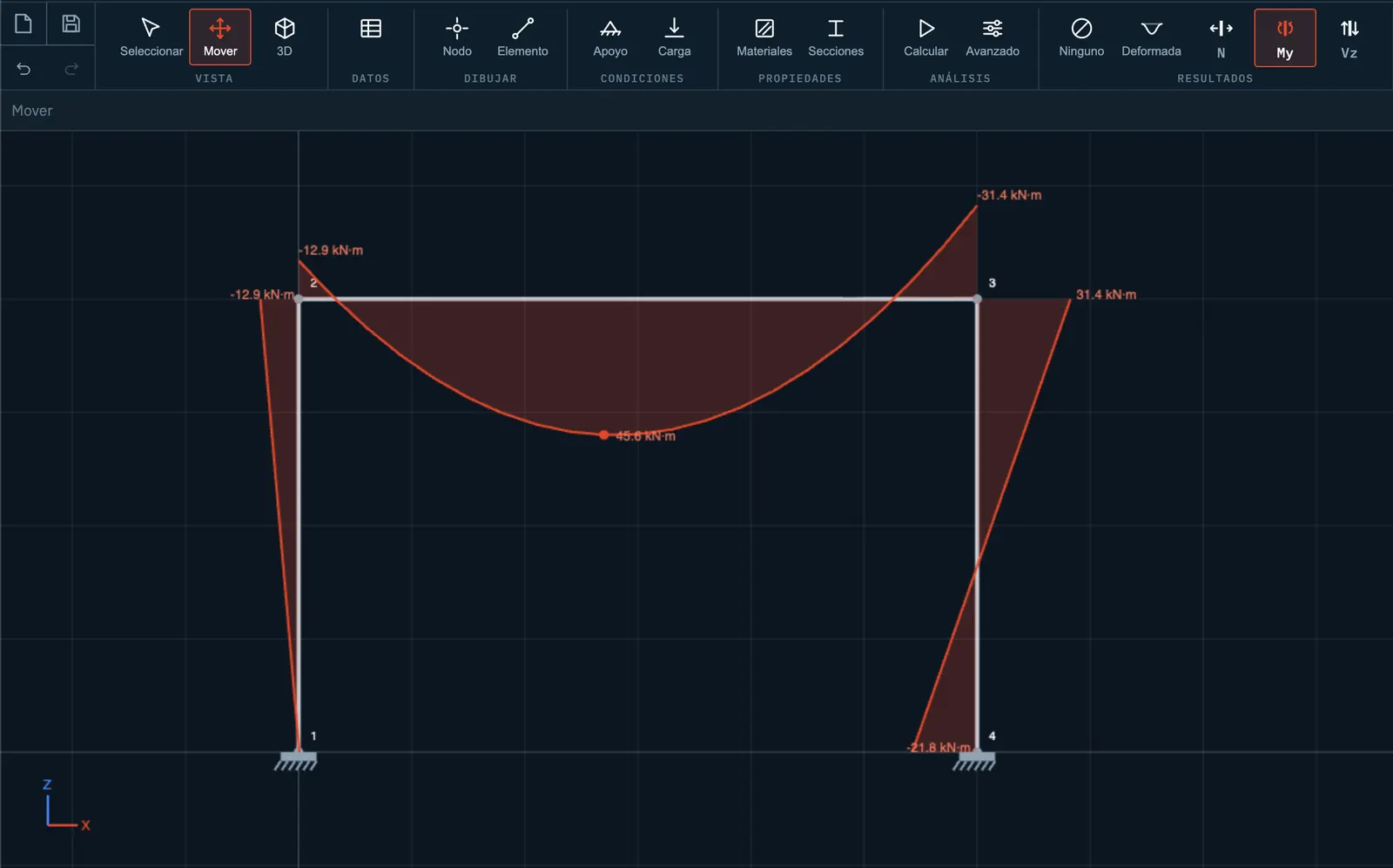
Axial force, bending moment and shear diagrams, and the deformed shape.
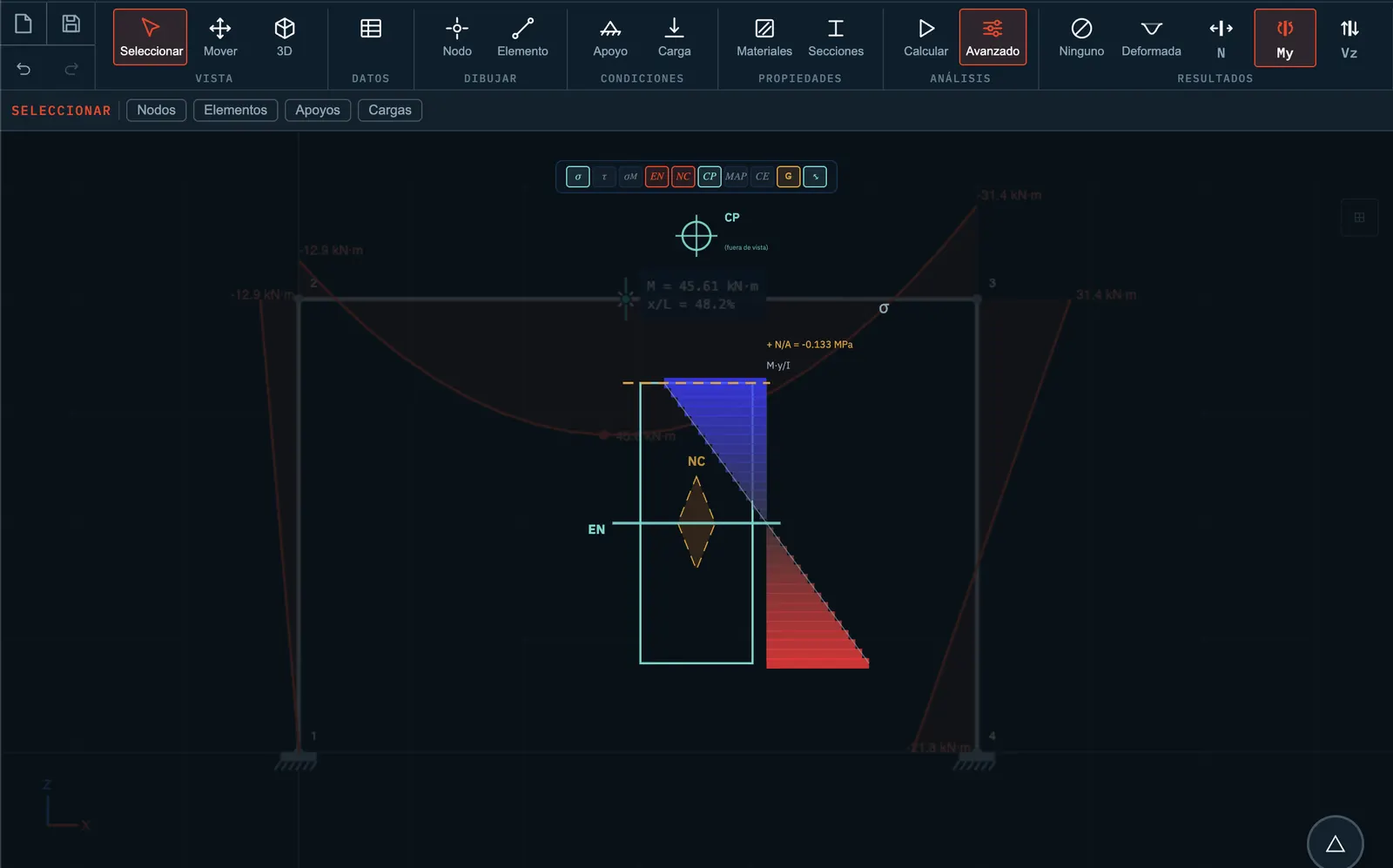
Click anywhere on the structure and see the whole stress state, with the theory that produced it in view — worked through step by step for the centroid, the shear centre, the core and several more.
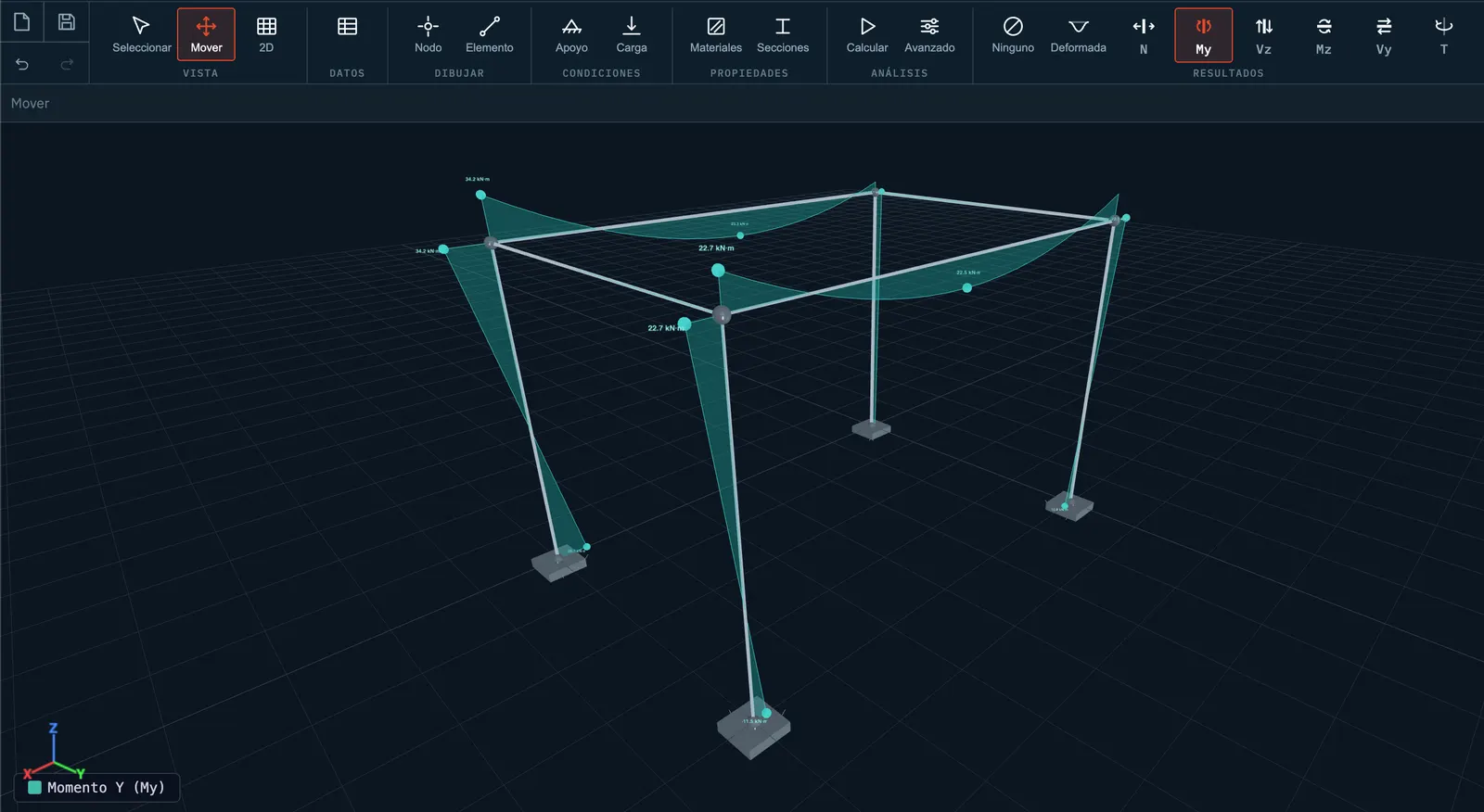
N, My, Vz, Mz, Vy and T diagrams, with the deformed shape in 3D.
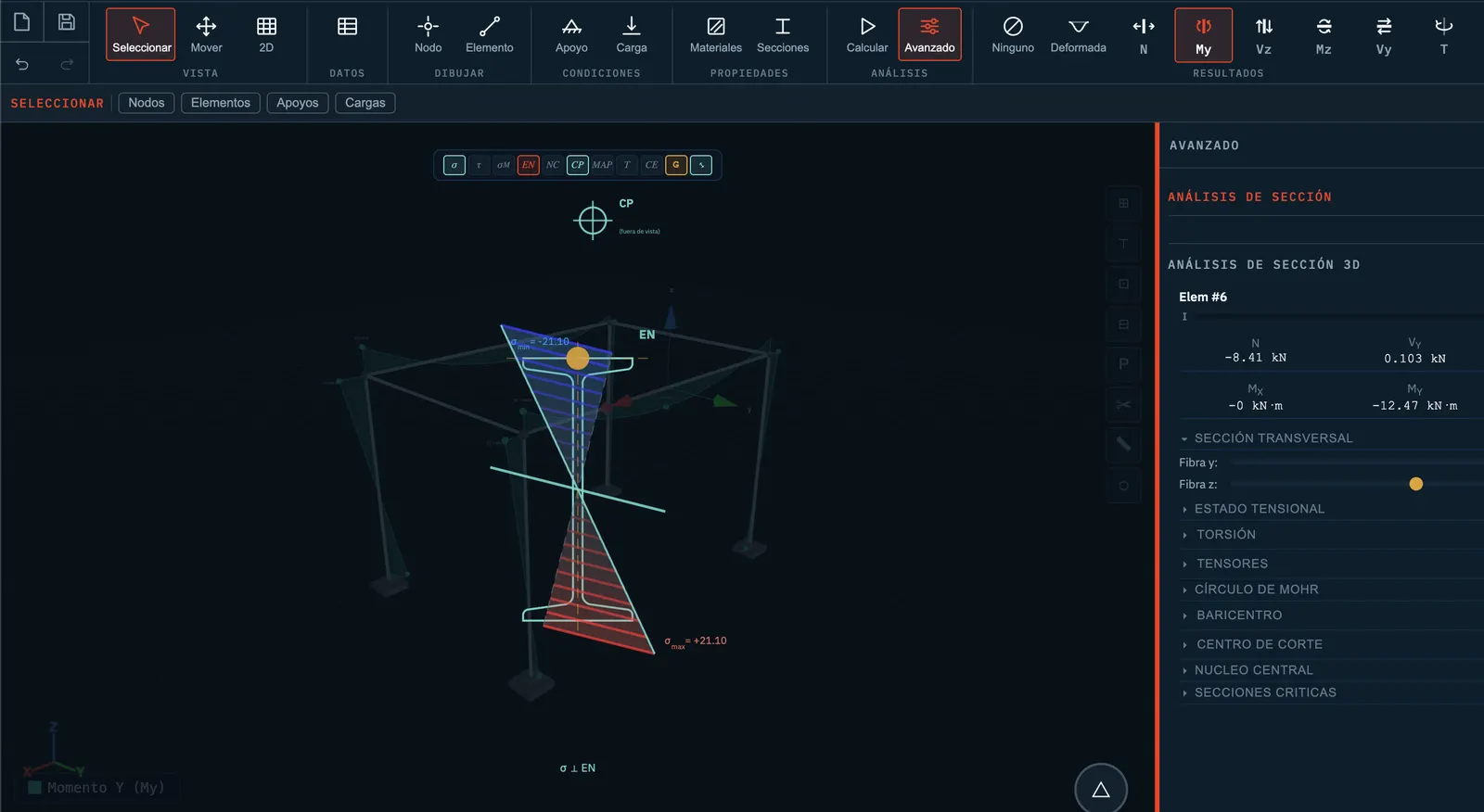
N/A + Mz·y/Iz + My·z/Iy with separate shear components, the oblique neutral axis, and torsion through three theories.
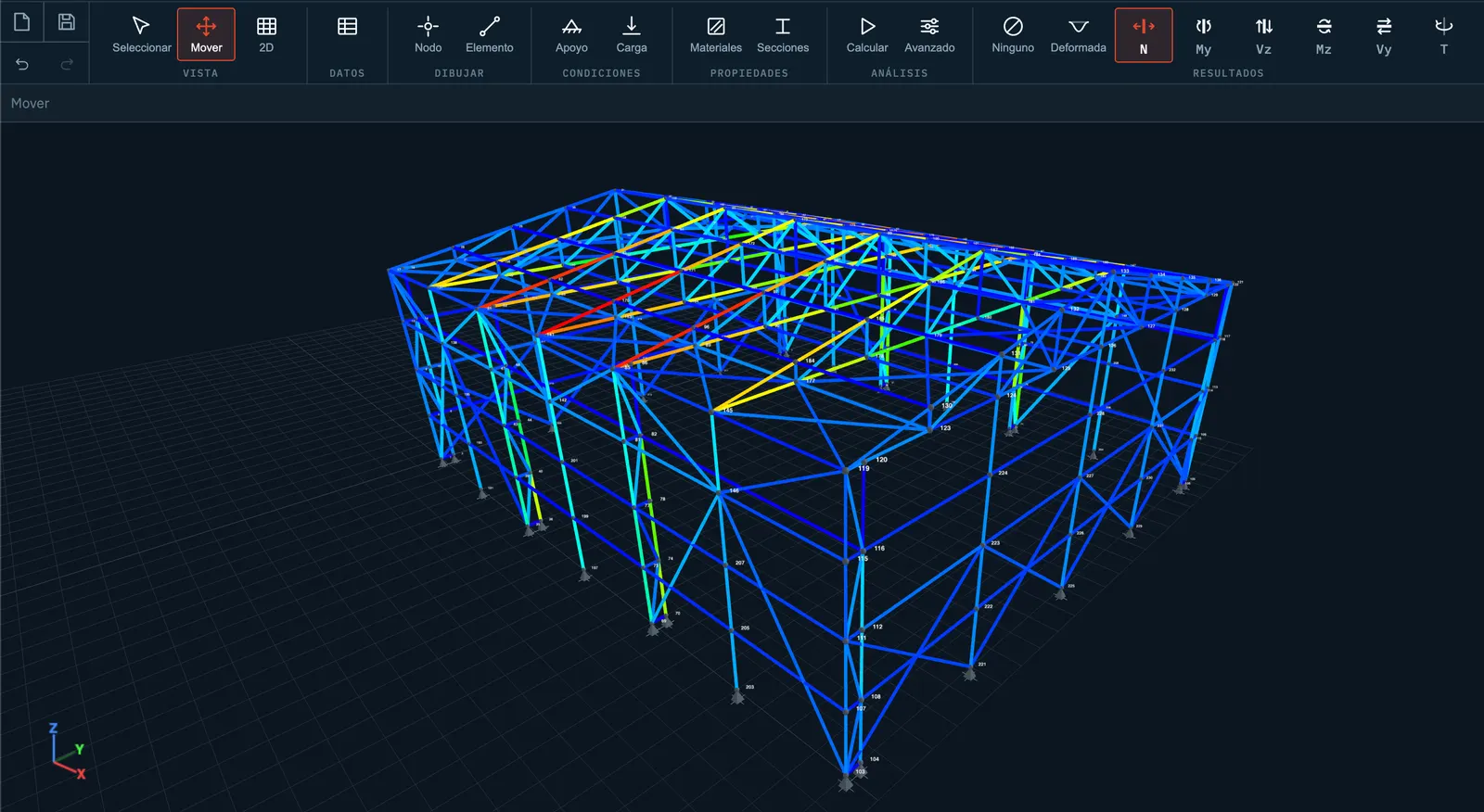
Thirty-seven models come in the examples menu, from a single beam to a whole industrial shed like this one. They are not a closed catalogue either: in Basic you model and solve whatever structure you want.
Basic is the most developed mode in Stabileo. Education and PRO build further workflows on the same structural-analysis foundation.
05 SOLVER CAPABILITIES
The same engine serves all three modes. Deeper analyses belong to PRO, while some solver capabilities continue to expand.
LINEAR
NONLINEAR
ELEMENTS
TIME-DEPENDENT
06 VALIDATION & EVIDENCE
Not self-certification: each analysis type is validated against published benchmarks and reference software.
VALIDATED AGAINST
5,655
Engine-coupled tests
Passing, 0 failures · measured at 6c3369d6 · 2026-08-01
55
Built-in example models
Ship with the app, from a cantilever to a stadium · 37 in the examples menu
69
GitHub stars
github.com/lambdaclass/stabileo
AGPL-3.0
Licence
Public repository, inspectable method
22–89× faster factorisation on shell meshes, and 22× end to end. Sparse Cholesky with AMD ordering, measured in this repository against Stabileo’s own dense path, not against other vendors.
The solver is WebAssembly and runs inside your browser, so your model stays on your machine while it is analysed.
07 CODES & INTEROPERABILITY
Member checking already spans the main international codes. Code-based design, meaning proposing a design and generating reinforcement, is being built out one framework at a time.
Stabileo is built in Argentina, so CIRSOC comes first: it is the Argentine regulatory framework and the one this work answers to, and it is where code-based design is furthest along. The roadmap continues with the Eurocodes, and then with the United States codes.
CIRSOC 101
2025
AVAILABLE TODAYGenerated from the model: self weight, partition allowance, the minimum imposed loads of Table 4.1, live-load reduction, and the seven strength combinations verbatim.
Further load types will follow.
CIRSOC 102
2025
AVAILABLE TODAYVelocity pressure, exposure and terrain constants, topography, gust effect, enclosure classification and the wall and roof pressure coefficients, applied to the main wind-force resisting system.
Non-rigid buildings and torsional load cases will be added.
CIRSOC 201
2025
PARTIAL · IN TESTINGThe strongest coverage of any code here. Beams and columns are both verified and generated: flexure, shear, ties, bar regions, spacing, anchorage and lap lengths, each result carrying its clause. Slabs, walls and pad footings are designed too, reachable from the workflow, and their results are labelled provisional.
Finishing development, and being tested against real projects.
CIRSOC 301
2018
PARTIALA checker for steel members on the AISC 360 LRFD basis: tension, compression, flexure with lateral-torsional buckling, shear and combined actions.
Code-based design in development.
INPRES-CIRSOC 103
I 2018 · II 2005
IN DEVELOPMENTEffective seismic weight and the static-method distribution of base shear up the height are already generated.
Code-based seismic workflow in development.
INTERNATIONAL CODES · MEMBER CHECKING
The solver rates a member you designed against each of these today.
AISC 360
Steel
ACI 318
Reinforced concrete
AISI S100
Cold-formed steel
NDS · TMS 402
Timber and masonry
EN 1993-1-1
Eurocode · steel
EN 1992-1-1
Eurocode · concrete
08 EDUCATION MODE
A student-exercise layer built on the same structural-analysis engine. Teachers write exercises inside the app, hand them out as a link and get the answers back; what is still missing is the layer above that — the course.
WORKS TODAY
IN DEVELOPMENT
What exists is the exercise and the round trip around it: a teacher writes one, hands it out, and reads the answers back. What does not exist is the course around THAT — assignments, a class list, attempts, a mark that lives anywhere. Stabileo stores nothing on a server, so an exercise and a submission travel as a link, a file or a code, the way work is already handed in. The step-by-step stiffness-method lessons are available as part of Basic.
The educational core is intended to stay free for educational use.
09 PRO MODE
Finite-element analysis and complex models already work here, at the level you would expect from a professional package. What is still being polished is design to the regulations: the step many finite-element programs stop short of, handing you results and leaving the code check to you.
USABLE NOW
IN DEVELOPMENT
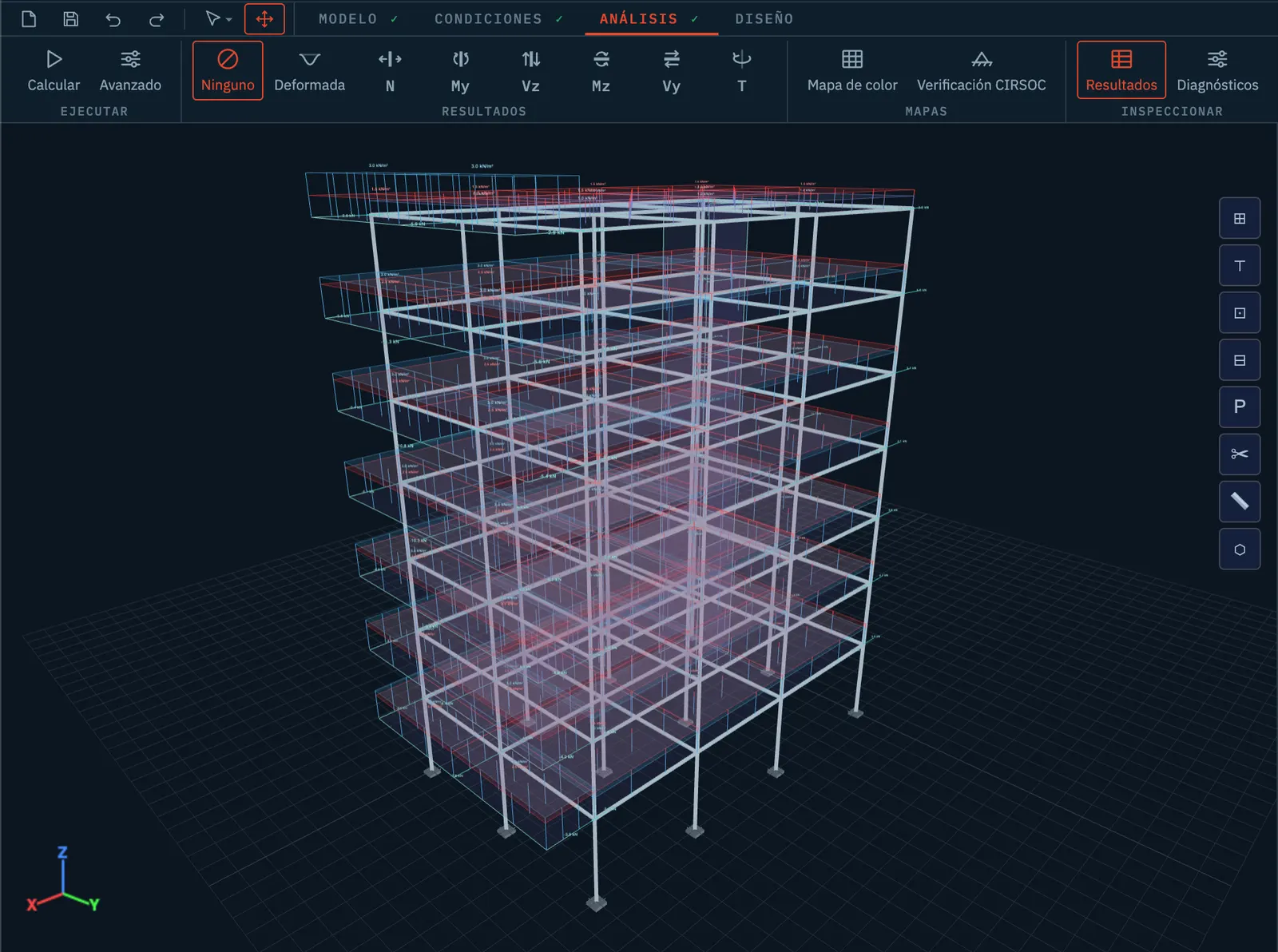
Frames, slabs and their loads, modelled in the browser. Bars and plates together, which is what a real building is.
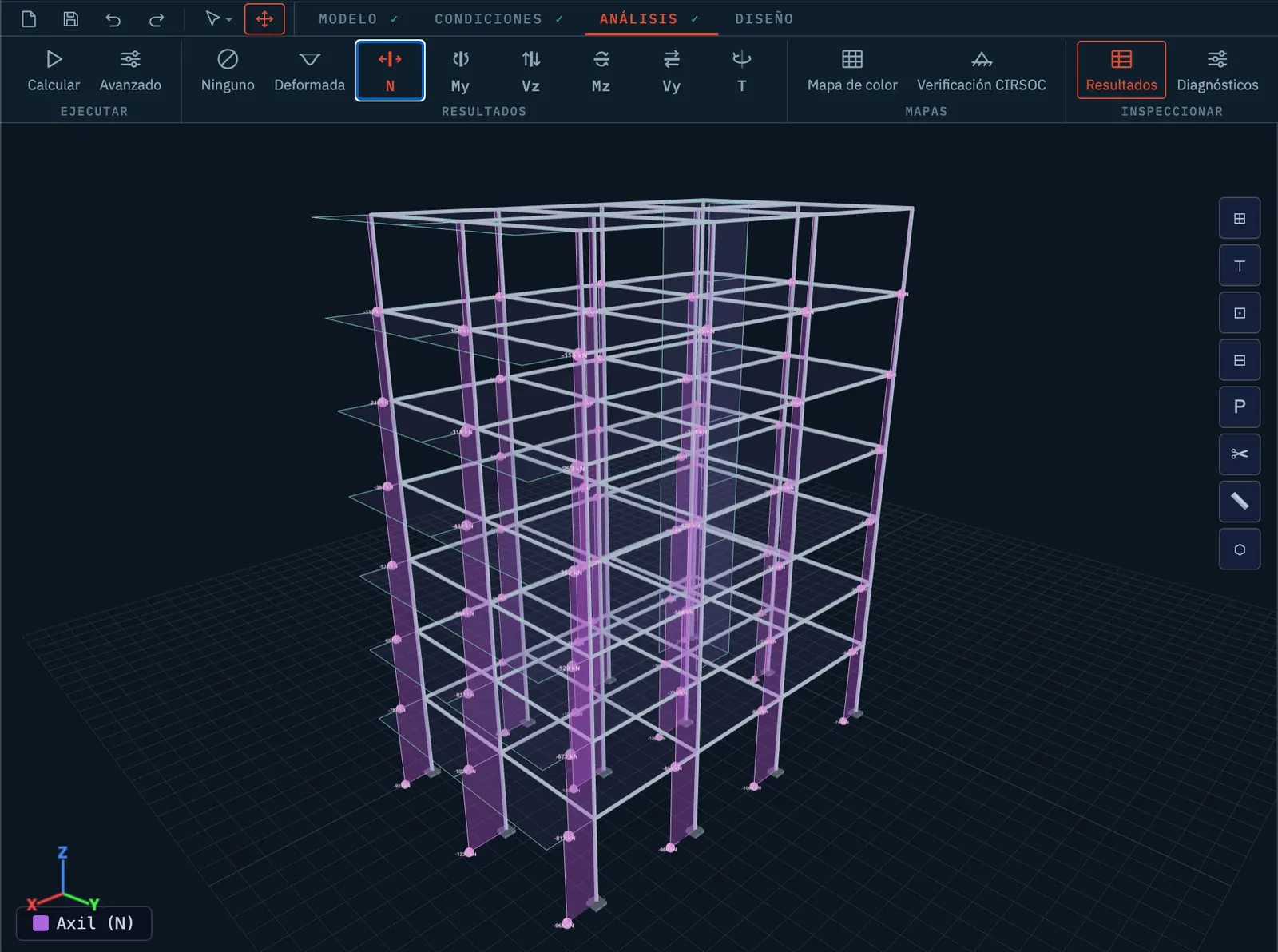
Axial force on every column, read straight off the model. Finite elements on a structure of this size already work.
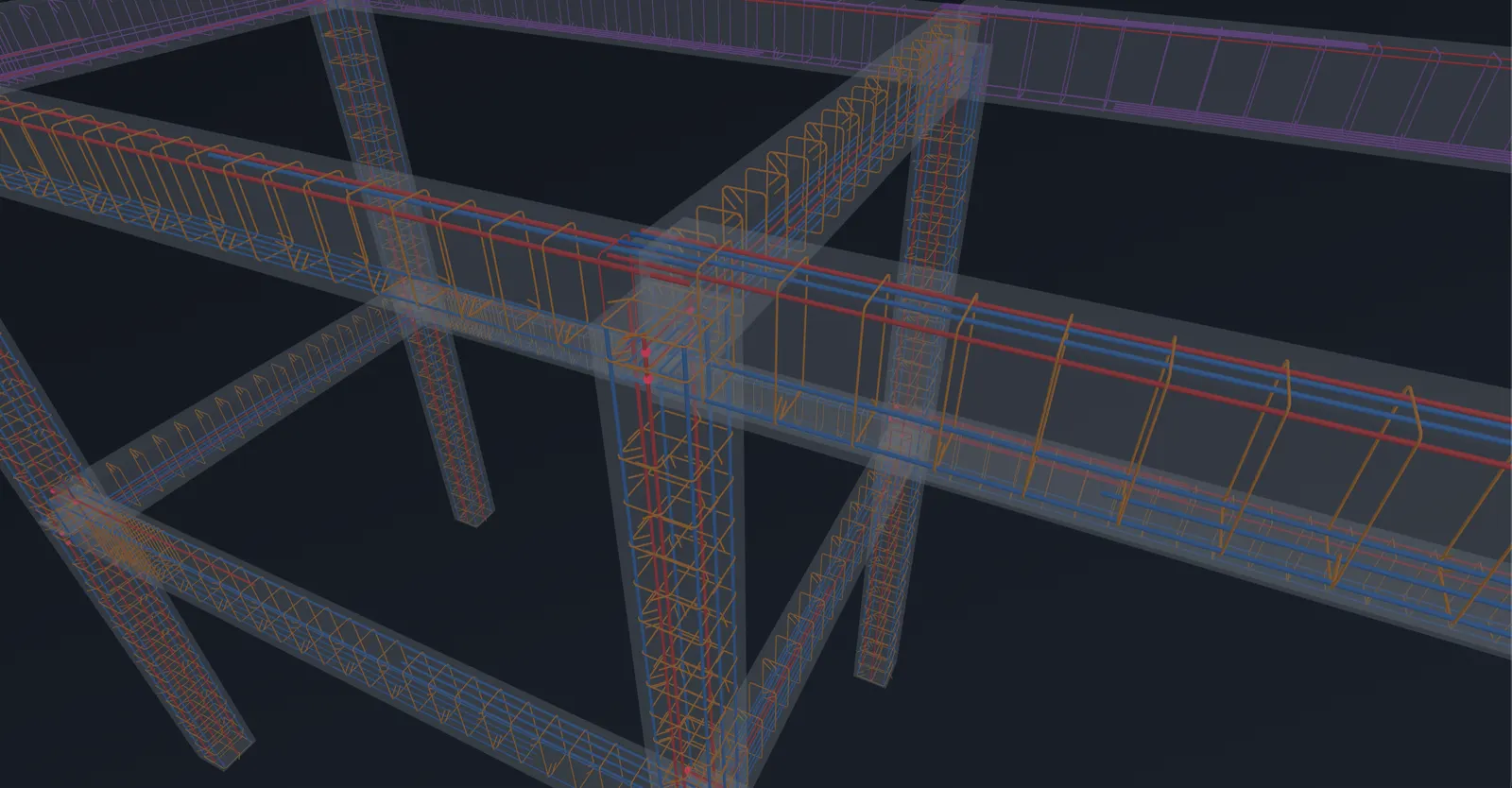
Longitudinal bars and stirrups placed to CIRSOC 201, on the model rather than on a separate drawing. In development.
Real captures of the application, not renders. The reinforcement view is in development; everything else in this section states its own maturity above.
10 THE THESIS
Generative AI produces the plausible, not the correct, and it cannot tell the two apart. What makes it dependable is a deterministic environment that validates it. The architecture that already works is always the same: a generator that explores and a verifier that guarantees.
GENERATOR
It generates and edits the structured model: geometry, loads, sections, assumptions.
VERIFIER
The deterministic solver resolves the real mechanics. It is the source of truth, and there is no magic in the prompt.
CODE + COMPILER/TESTS
Coding agents work because something tells them whether it compiles and passes.
MATHEMATICS + LEAN
AlphaProof proves theorems because a formal verifier lets no error through.
STRUCTURES + STABILEO
AI can design because the solver validates every result against physics.
Stabileo AI is in active development. The agent routes already run in development and testing against a dedicated backend, on the same solver and the same numbers as everything else on this page. That backend is not part of the public site yet, so this section describes the direction rather than a service you can open today. The engineer still signs the work.
IN DEVELOPMENT
Stabileo’s solver is the compiler of the physical world.
11 PRODUCT STATUS
Everything that ships is marked as shipped, everything in progress carries its status, and none of it is required to use Stabileo.
Stabileo is free software under AGPL-3.0, and the solver runs on your own machine. There is no price, no account and no licence key.
The core application is intended to stay free for educational use, and the Education and PRO layers grow on top of it.
The hosted services marked ROADMAP are still ahead, and using Stabileo will never depend on them.
12 DOCUMENTATION
Formulation, conventions and workflow, in the repository, versioned with the code.
No install, no account. The first model takes a minute.
BLOG
Longer pieces on how the solver works, what the code checks actually verify, and the decisions behind them. Written by the people who write the code, with the numbers computed rather than remembered.
LATEST
A language model cannot guarantee a number is right; a verified solver can. The architecture that makes AI useful in structural engineering keeps the two apart.
Read this post