Research in structural engineering
Classic and recent papers, benchmarks and methods you can run and check in Stabileo, the structural engineering software with AI. Each page states what is reproduced and how it was checked.
Research, not a design tool. Nothing here is an engineering result; agreement with a reference code is not a certification. Contributions: CONTRIBUTING.md.
Run it

Lee frame (1968)
A pinned L-frame traced through its first limit point with Stabileo’s production corotational arc-length solver.
Large Deflections and Stability of Elastic Frame. Seng-Lip Lee, Francisco S. Manuel, Edwin C. Rossow, Journal of the Engineering Mechanics Division, 1968.
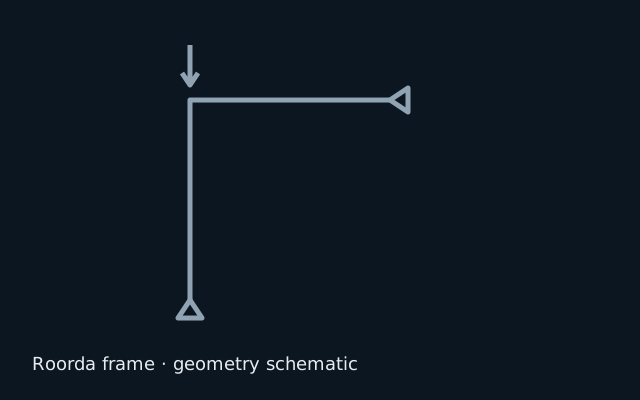
Roorda frame: buckling and nonlinear path
Buckling compared with the published scalar values; the imperfect arc-length path is checked against the native solver replay.
Optimization of the Initial Post‐Buckling Response of Trusses and Frames by an Asymptotic Approach. Federico Ferrari, Ole Sigmund, International Journal for Numerical Methods in Engineering, 2025.

Topology optimization of an MBB beam
Redistribute material using SIMP and compare both filters against the authors’ code.
Efficient topology optimization in MATLAB using 88 lines of code. Erik Andreassen, Anders Clausen, Mattias Schevenels et al., Structural and Multidisciplinary Optimization, 2011.

Four cables, one equilibrium
Find the shape of the four-bar system in Fig. 2 using positive force densities. Change the load, recompute in Rust, then open the found geometry as a truss in Stabileo.
Differentiable force density method for the design of lightweight structures. Rafael Pastrana, Deniz Oktay, Kai-Uwe Bletzinger et al., Computer Methods in Applied Mechanics and Engineering, 2026.
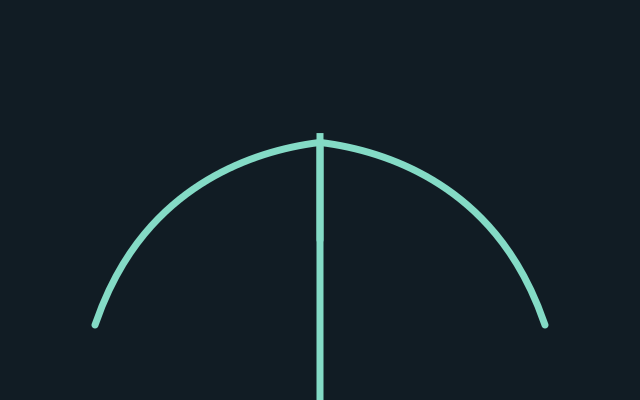
A square gridshell under its own weight
One five-node example from Fairclough and colleagues: four supports, one central load, and four curved compression members.
Topology and geometry optimization of grid-shells incorporating design-dependent self-weight loading. Helen E. Fairclough, Karol Bołbotowski, Linwei He et al., Computers & Structures, 2026.
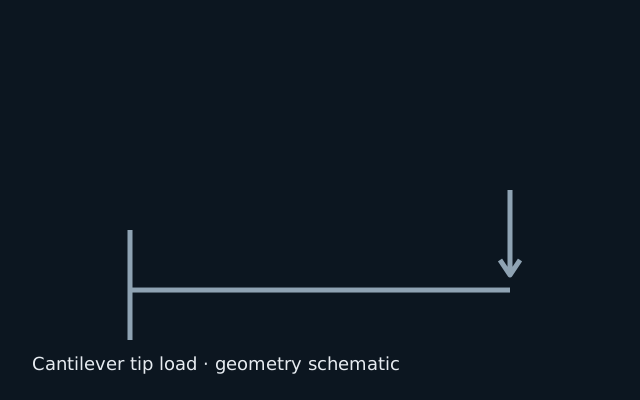
Mattiasson (1981): cantilever elastica
Trace the production corotational solver as a cantilever curls, checked against independent elliptic-integral references.
Numerical results from large deflection beam and frame problems analysed by means of elliptic integrals. Kjell Mattiasson, International Journal for Numerical Methods in Engineering, 1981.
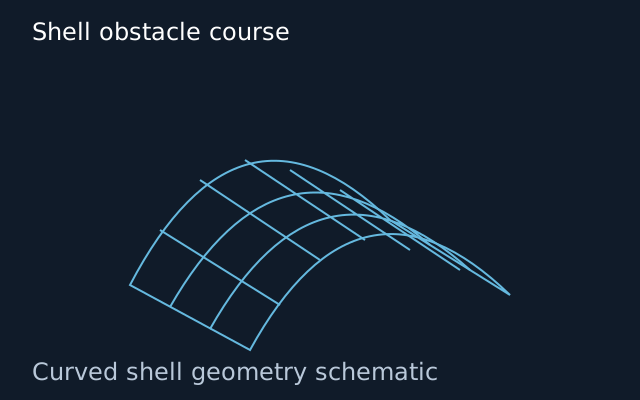
Shell obstacle course — Belytschko et al. (1985)
Refine the roof, cylinder and hemisphere; inspect live production-engine accuracy, including failures.
Stress projection for membrane and shear locking in shell finite elements. Ted Belytschko, Henryk Stolarski, Wing Kam Liu et al., Computer Methods in Applied Mechanics and Engineering, 1985.
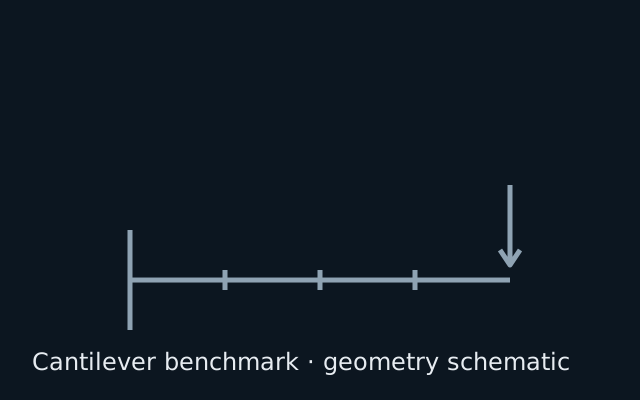
MacNeal–Harder (1985): engine benchmarks
Run the production engine on MacNeal–Harder cantilever cases; inspect every result, including failures.
A proposed standard set of problems to test finite element accuracy. Richard H. Macneal, Robert L. Harder, Finite Elements in Analysis and Design, 1985.
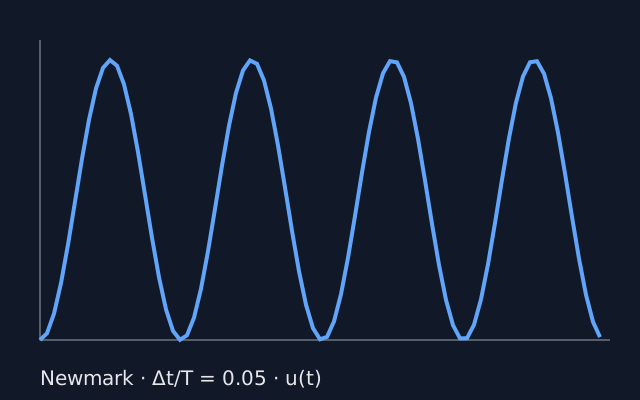
Newmark average acceleration
One undamped degree of freedom under a sudden constant force. Increase the time step to see the numerical period grow.
A Method of Computation for Structural Dynamics. Nathan M. Newmark, Journal of the Engineering Mechanics Division, 1959.

Classic plastic collapse
One fixed-base portal, three hand-calculated mechanisms, and the production 3D plastic-collapse solver.
Plastic Theory of Structures. M. R. Horne, Pergamon Press, 1979.
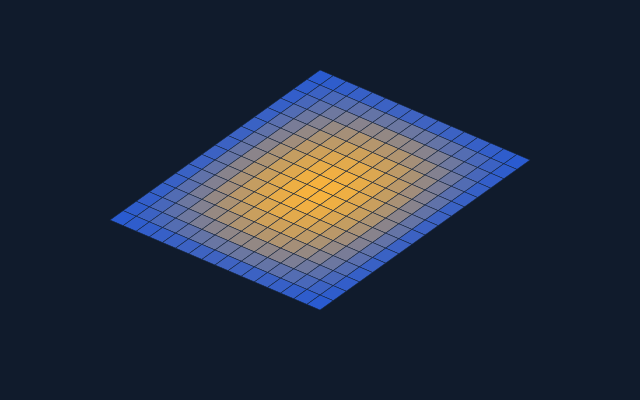
Navier plate: mesh convergence
One simply supported rectangular plate, uniform pressure, two production elements and a double Fourier series.
Rectangular Plates. Eduard Ventsel, Theodor Krauthammer, Thin Plates and Shells, 2001.

DaDeppo–Schmidt: a deep arch at its limit
A 215° arch, a crown load and the production arc-length solver, checked against the published limit load and crown state.
Instability of Clamped-Hinged Circular Arches Subjected to a Point Load. D. A. DaDeppo, R. Schmidt, Journal of Applied Mechanics, 1975.

Phase-field fracture of a notched plate
Pull a notched plate apart and watch an AT2 phase-field crack form and run, solved in your browser and checked step by step against the author’s code.
Less than 500 lines self-contained Python finite element implementation of the phase-field method for fracture mechanics. Nathan Shauer, Advances in Engineering Software, 2025.
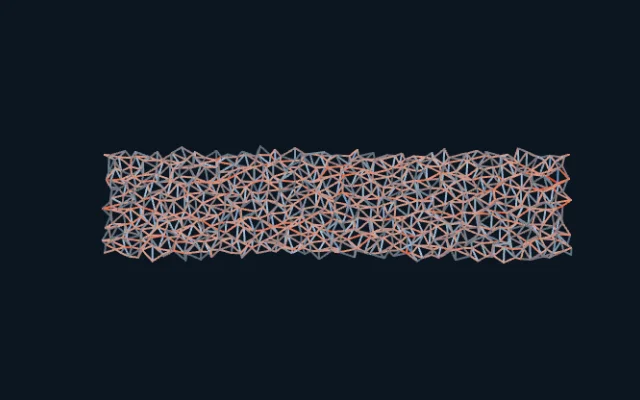
Auxetic spring networks
Shake the nodes of a triangular lattice of springs until it widens when pulled: a truss network solved in your browser, against the paper’s published numbers.
Predicting the mechanical properties of spring networks. Doron Grossman, Arezki Boudaoud, Physical Review Research, 2026.

Snapping arches by curvature patterning
Change the width of a curved segment and move the threshold at which a shallow arch switches sides.
Snapping and switching of elastic arches with patterned preferred curvature. Michał Zmyślony, Ammar Khan, John S. Biggins, Physical Review Research, 2026.

Steering a bent strip between two shapes
Turn the two clamps of an actively bent strip under a fixed load and take it from an arch to its inverted shape without a snap.
Quasi-static shape control of structures with topologically complex equilibrium sets. Eszter Fehér, András Á. Sipos, Péter L. Várkonyi, European Journal of Mechanics - A/Solids, 2026.
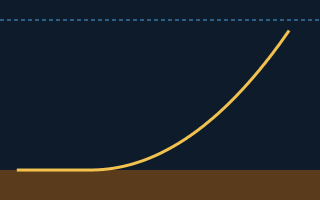
A riser lifted off the seabed
Pull a notched plate apart and watch an AT2 phase-field crack form and run, solved in your browser and checked step by step against the author’s code.
Static analysis of offshore risers with a geometrically-exact 3D beam model subjected to unilateral contact. Alfredo Gay Neto, Clóvis A. Martins, Paulo M. Pimenta, Computational Mechanics, 2013.
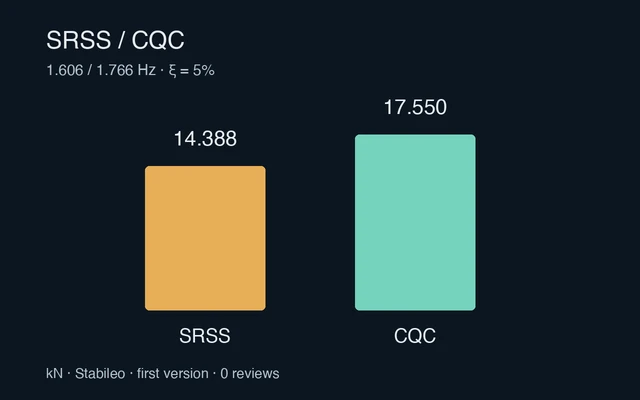
Closely spaced modes: SRSS vs CQC
One small 3D shear-building idealization, solved by the production modal and response-spectrum engine.
A replacement for the srss method in seismic analysis. E. L. Wilson, A. Der Kiureghian, E. P. Bayo, Earthquake Engineering & Structural Dynamics, 1981.

Arc-length benchmarks: Riks and Crisfield
Compare two-bar frame equilibrium paths with analytical references; the slender von Mises case passes its upper limit point.
An incremental approach to the solution of snapping and buckling problems. E. Riks, International Journal of Solids and Structures, 1979.
On our list: papers we plan to reproduce
-
Controlling the snap-through behavior of an elastica strip by cuts
Eszter Fehér, European Journal of Mechanics - A/Solids, 2026 · doi:10.1016/j.euromechsol.2026.106217
Studies how symmetric cuts change the stability of an initially flat strip bent between vertical clamps and loaded at its midpoint, using a variable-stiffness elastica model.
Summary in our words, from the paper.
-
A framework for structural shape optimization based on automatic differentiation, the adjoint method and accelerated linear algebra
Gaoyuan Wu, Structural and Multidisciplinary Optimization, 2023 · doi:10.1007/s00158-023-03601-0
Code: GaoyuanWu/JaxSSO (MIT)
-
On benchmarking and good scientific practise in topology optimization
Ole Sigmund, Structural and Multidisciplinary Optimization, 2022 · doi:10.1007/s00158-022-03427-2
-
Giga-voxel computational morphogenesis for structural design
Niels Aage, Erik Andreassen, Boyan S. Lazarov et al., Nature, 2017 · doi:10.1038/nature23911
-
Ultralight, ultrastiff mechanical metamaterials
Xiaoyu Zheng, Howon Lee, Todd H. Weisgraber et al., Science, 2014 · doi:10.1126/science.1252291
Octet-truss microlattices made by projection microstereolithography from polymers, metals and ceramics. Because their struts carry load axially instead of bending, the materials are very stiff and strong for their low density.
Summary in our words, from the abstract.
-
Topological boundary modes in isostatic lattices
C. L. Kane, T. C. Lubensky, Nature Physics, 2013 · doi:10.1038/nphys2835
-
A critical review of established methods of structural topology optimization
G. I. N. Rozvany, Structural and Multidisciplinary Optimization, 2008 · doi:10.1007/s00158-007-0217-0
-
Crowd synchrony on the Millennium Bridge
Steven H. Strogatz, Daniel M. Abrams, Allan McRobie et al., Nature, 2005 · doi:10.1038/438043a
-
On “A proposed standard set of problems to test finite element accuracy”: the twisted beam
D. Zupan, M. Saje, Finite Elements in Analysis and Design, 2004 · doi:10.1016/j.finel.2003.10.001
Compares three interpretations of an initially twisted beam with different twist distributions and cross-sections. The numerical results identify the MacNeal-Harder reference as a linearly twisted beam with curved edges.
Summary in our words, from the abstract.
-
Layout optimization of large-scale pin-jointed frames
Matthew Gilbert, Andrew Tyas, Engineering Computations, 2003 · doi:10.1108/02644400310503017
Ground-structure layout optimization of trusses is limited by the number of potential members. The paper presents an iterative member-adding method, built on linear-programming column generation, that starts from a sparsely connected ground structure and adds members as needed until the provably optimal layout is reached, handling problems with very large numbers of potential members.
Summary in our words, from the abstract.
-
A 99 line topology optimization code written in Matlab
O. Sigmund, Structural and Multidisciplinary Optimization, 2001 · doi:10.1007/s001580050176
-
An evaluation of the MITC shell elements
Klaus-Jürgen Bathe, Alexander Iosilevich, Dominique Chapelle, Computers & Structures, 2000 · doi:10.1016/s0045-7949(99)00214-x
Evaluates MITC shell elements on selected test problems using fundamental shell-analysis criteria. The reported results support their use for general engineering applications.
Summary in our words, from the paper.
-
Fundamental considerations for the finite element analysis of shell structures
D. Chapelle†, K.J. Bathe, Computers & Structures, 1998 · doi:10.1016/s0045-7949(97)00078-3
Explains how geometry and boundary conditions determine whether a thin shell is dominated by membrane action or bending. Proposes test cases for evaluating convergence and its dependence on shell thickness.
Summary in our words, from the abstract.
-
Higher‐order MITC general shell elements
Miguel Luiz Bucalem, Klaus‐Jüen Bathe, International Journal for Numerical Methods in Engineering, 1993 · doi:10.1002/nme.1620362109
Presents nine-node and sixteen-node MITC shell elements that tie interpolated covariant membrane and shear strains to the displacement field. Numerical tests assess their predictive performance.
Summary in our words, from the abstract.
-
Generating optimal topologies in structural design using a homogenization method
Martin Philip Bendsøe, Noboru Kikuchi, Computer Methods in Applied Mechanics and Engineering, 1988 · doi:10.1016/0045-7825(88)90086-2
-
A simple error estimator and adaptive procedure for practical engineerng analysis
O. C. Zienkiewicz, J. Z. Zhu, International Journal for Numerical Methods in Engineering, 1987 · doi:10.1002/nme.1620240206
Presents an inexpensive estimator of global energy-norm and local finite element errors. The estimates guide adaptive refinement or mesh redesign to reach a chosen accuracy.
Summary in our words, from the abstract.
-
A formulation of general shell elements—the use of mixed interpolation of tensorial components
Klaus‐Jürgen Bathe, Eduardo N. Dvorkin, International Journal for Numerical Methods in Engineering, 1986 · doi:10.1002/nme.1620220312
Discusses practical requirements for general shell elements, explains a four-node mixed-interpolation formulation and introduces an eight-node element using the same approach.
Summary in our words, from the abstract.
-
Stress projection for membrane and shear locking in shell finite elements
Ted Belytschko, Henryk Stolarski, Wing Kam Liu et al., Computer Methods in Applied Mechanics and Engineering, 1985 · doi:10.1016/0045-7825(85)90035-0
-
A four‐node plate bending element based on Mindlin/Reissner plate theory and a mixed interpolation
Klaus‐Jürgen Bathe, Eduardo N. Dvorkin, International Journal for Numerical Methods in Engineering, 1985 · doi:10.1002/nme.1620210213
Derives a four-node linear elastic plate bending element as a special case of a general shell formulation and uses example solutions to assess its predictions.
Summary in our words, from the abstract.
-
A fast incremental/iterative solution procedure that handles “snap-through”
M.A. Crisfield, Computers & Structures, 1981 · doi:10.1016/0045-7949(81)90108-5
-
A replacement for the srss method in seismic analysis
E. L. Wilson, A. Der Kiureghian, E. P. Bayo, Earthquake Engineering & Structural Dynamics, 1981 · doi:10.1002/eqe.4290090207
Introduces complete quadratic combination for seismic modal maxima. In the examples studied it reduces modal-combination errors, and it approaches SRSS when natural frequencies are well separated.
Summary in our words, from the abstract.
-
A study of three‐node triangular plate bending elements
Jean‐Louis Batoz, Klaus‐JÜRgen Bathe, Lee‐Wing Ho, International Journal for Numerical Methods in Engineering, 1980 · doi:10.1002/nme.1620151205
Compares three-node triangular plate bending elements with nine displacement degrees of freedom. Theoretical and numerical assessments favour the discrete Kirchhoff and hybrid-stress formulations among the alternatives examined.
Summary in our words, from the abstract.
-
Buckminster Fuller's “Tensegrity” structures and Clerk Maxwell's rules for the construction of stiff frames
C.R. Calladine, International Journal of Solids and Structures, 1978 · doi:10.1016/0020-7683(78)90052-5
-
The force density method for form finding and computation of general networks
H.-J. Schek, Computer Methods in Applied Mechanics and Engineering, 1974 · doi:10.1016/0045-7825(74)90045-0
-
The stone skeleton
Jacques Heyman, International Journal of Solids and Structures, 1966 · doi:10.1016/0020-7683(66)90018-7
-
Stiffness and Deflection Analysis of Complex Structures
M. J. TURNER, R. W. CLOUGH, H. C. MARTIN et al., Journal of the Aeronautical Sciences, 1956 · doi:10.2514/8.3664
-
Variational methods for the solution of problems of equilibrium and vibrations
R. Courant, Bulletin of the American Mathematical Society, 1943 · doi:10.1090/s0002-9904-1943-07818-4
-
Solution of Problems of Elasticity by the Framework Method
A. Hrennikoff, Journal of Applied Mechanics, 1941 · doi:10.1115/1.4009129
Approximates an elastic continuum by a patterned framework of bars with suitable elastic properties. The approach covers several stress and bending problems and is illustrated with examples.
Summary in our words, from the abstract.
-
LXVI. On the correction for shear of the differential equation for transverse vibrations of prismatic bars
S.P. Timoshenko, The London, Edinburgh, and Dublin Philosophical Magazine and Journal of Science, 1921 · doi:10.1080/14786442108636264
-
LVIII. The limits of economy of material in frame-structures
A.G.M. Michell, The London, Edinburgh, and Dublin Philosophical Magazine and Journal of Science, 1904 · doi:10.1080/14786440409463229
-
L. On the calculation of the equilibrium and stiffness of frames
J. Clerk Maxwell, The London, Edinburgh, and Dublin Philosophical Magazine and Journal of Science, 1864 · doi:10.1080/14786446408643668