The 29th Argentine Structural Engineering Conference (JAIE) ran in Córdoba from 16 to 18 September, organised by the Asociación de Ingenieros Estructurales. On the last day we presented paper 86N, “Development of a structural calculation agent on a verified solver”, by Bautista Chesta, Raúl Bertero, Federico Carrone and Diego Kingston, in the track on artificial intelligence applied to civil engineering.
What we showed
The paper rests on one architectural rule: the AI agent interprets what the engineer asks for and proposes actions, but every number comes from the solver and the CIRSOC modules, which the agent cannot change. We call it the determinism boundary.
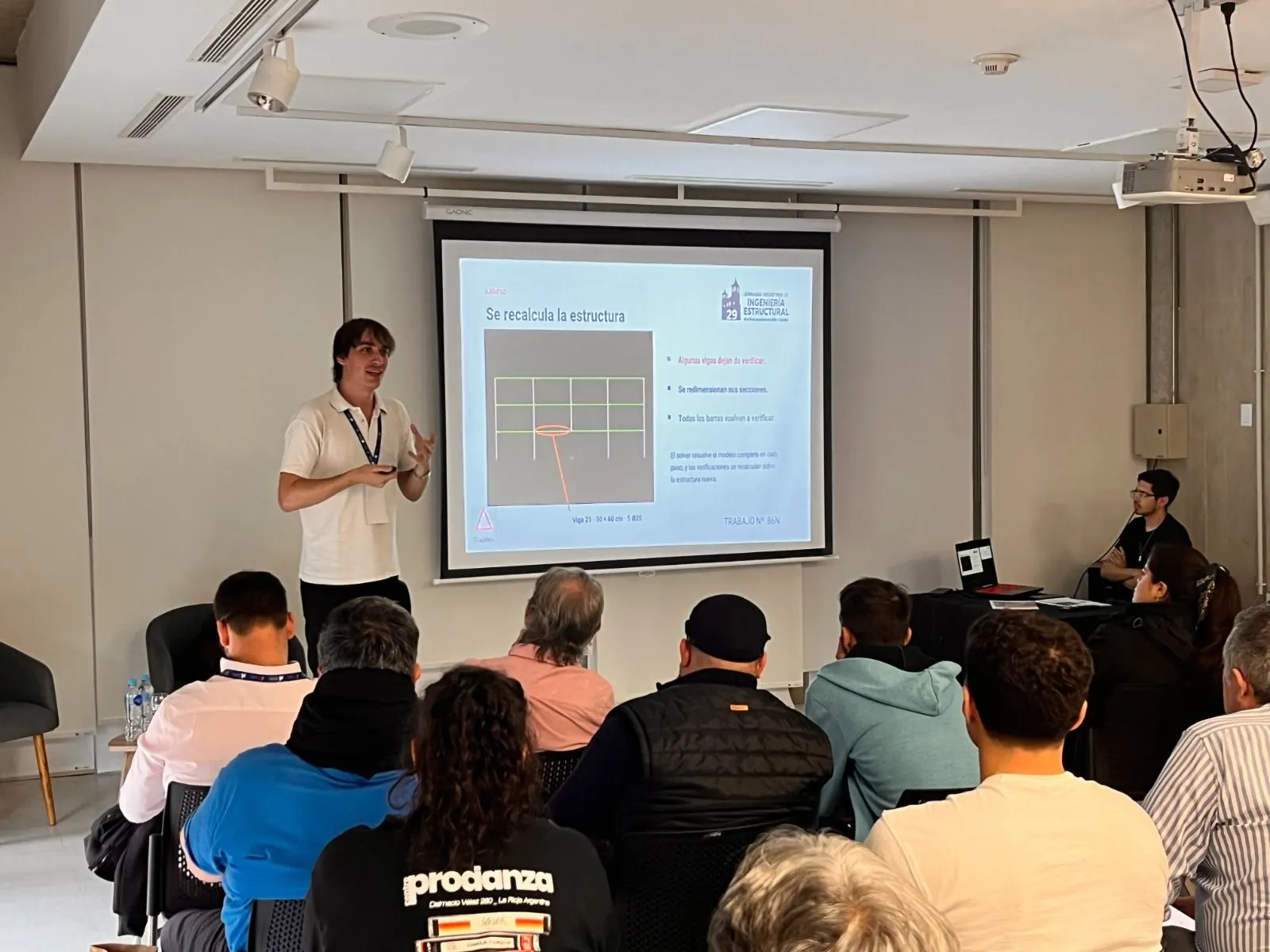
In the talk we showed it on a reinforced concrete portal frame that fails its check. The agent proposes a deeper beam, the solver solves the whole model again, and the CIRSOC 201 check is recomputed on the new structure: the demand/capacity ratio drops from 1.10 to 0.97. The paper reproduces that check by hand, step by step.
The second case was a four-bay, three-storey building with one column removed. Some beams stop passing, their sections are resized and every member passes again, with the solver solving the entire model at each step.
Why the boundary is needed
To show it, we gave general-purpose AI assistants the same preliminary sizing request fifteen times. They returned seven different sections. The most telling part: eleven runs agreed on the design moment and still proposed six different sections.
| What | Value |
|---|---|
| Runs of the same request | 15 |
| Different sections returned | 7 |
| Ratio of the largest to the smallest area | 1.80 |
| Runs that agreed on Mu = 207 kN·m | 11 |
| Different sections among those runs | 6 |
| Portal frame D/C before the correction | 1.10 |
| Portal frame D/C after the correction | 0.97 |
With a solver behind it, the same model gives the same number every time, and that number can be checked. That is what we want an engineer to be able to sign with confidence.
What we brought back
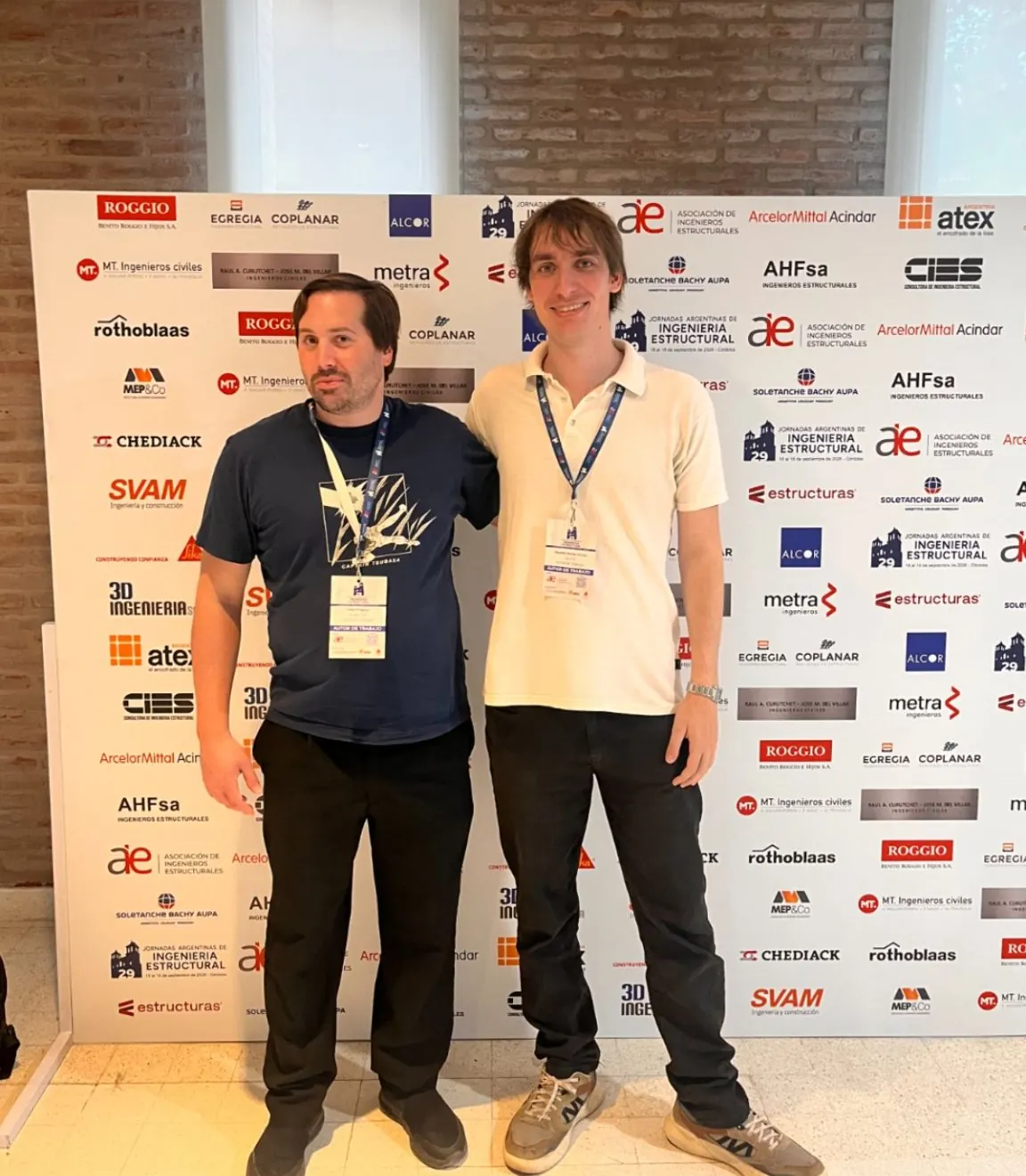
We came back with contacts among structural engineers from across the country and an invitation to join the structural engineers’ network. We also talked with universities in Córdoba about using it in their courses.
The full paper is at stabileo.com/paper, and Stabileo runs in the browser with nothing to install.